



Data and insights on organizational models
PLINK’s research on organizational models and corporate governance in Italy
PLINK commissioned a research in order to quantitatively analyze (with data and insights) how Italian companies are currently approaching their organizational models, decision-making processes, and the introduction of technologies such as Artificial Intelligence within their internal structures. All of the evidence collected serves as a scientific foundation for the Eulero Project, PLINK’s organizational governance model. The full results are available in a downloadable PDF here. Our study involved 250 companies, including both manufacturing and service organizations.
Business owners, CEOs, and general managers were interviewed.
How are Italian companies organized today?
The most common model: the traditional hierarchical structure
Nearly 8 out of 10 companies report adopting a pyramidal hierarchical organizational model, characterized by vertical functions and centralized processes.
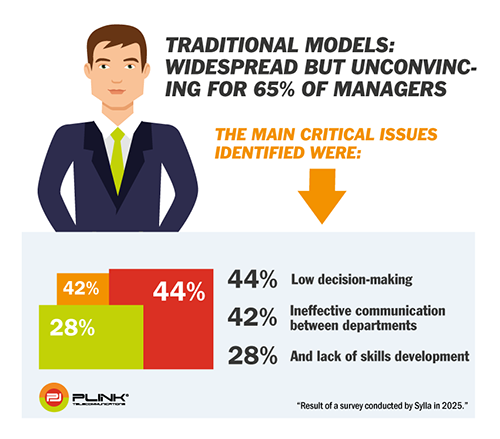
The most frequent governance issues
- 44% – slow decision-making
- 42% – poor communication between departments
- 28% – difficulty in valuing skills and talent
These numbers show the widespread need to renew corporate governance through more collaborative and adaptive models.
Openness to alternative organizational models
Despite the dominance of the hierarchical model, managers show strong openness toward more “horizontal” and evolved organizational forms.
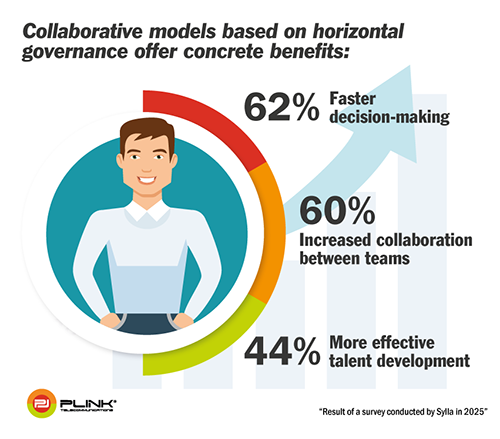
Perceived benefits of adopting alternative models
- 62% → faster and more flexible decision-making processes
- 59.6% → increased collaboration across teams
- 4.4% → Increased value placed on individual skills
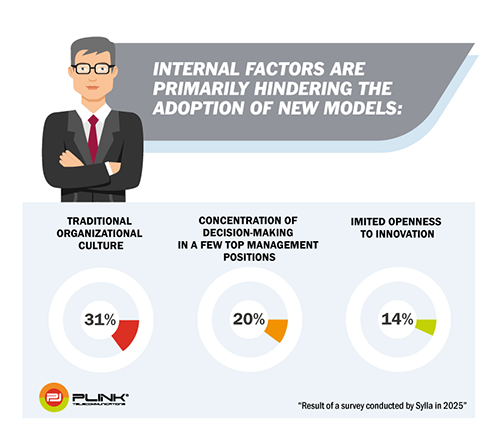
Main obstacles to changing corporate governance
- 31% → traditional company culture and organizational inertia
- 20% → central role of ownership and limited delegation
- 14% → lack of innovation openness
Eulero Project was designed precisely to address these elements and support companies transitioning toward truly collaborative models.
The impact of artificial intelligence on governance
What’s the most surprising data point?
Despite the introduction of AI into the company, 100% of respondents do not perceive an increased turnover risk.
AI is instead seen as an enabling factor within corporate governance, particularly for coordinating processes and improving operational flow.
Research-based organizational profiles
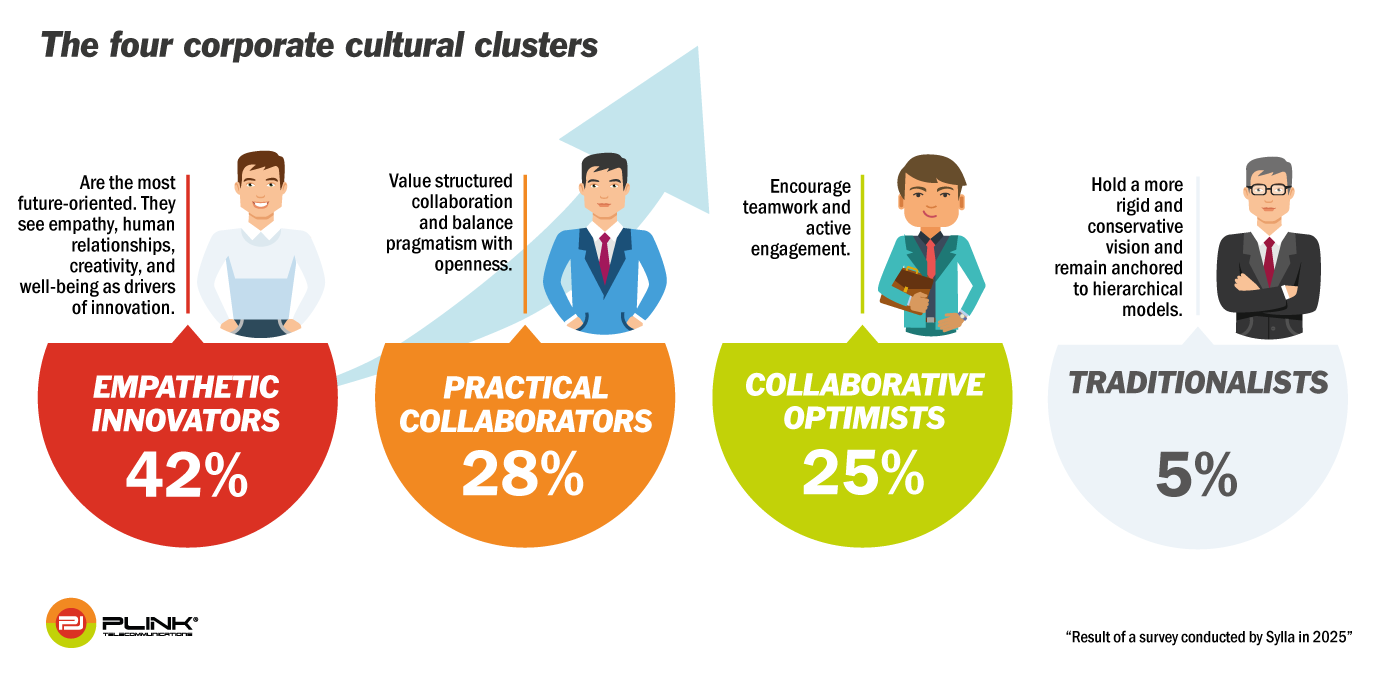
The study identifies four statistically distinct groups of entrepreneurs and managers, offering a clear map of the cultural orientations present today in Italian companies:
1. Empathic innovators (42%)
Strong focus on employee well‑being and a high degree of openness toward collaborative organizational models.
2. Practical collaborators (28%)
An advocate of non-hierarchical models, but prefers more linear and pragmatic structures.
3. Traditionalists (5%)
Attached to rigid governance models, with strong skepticism toward AI and more fluid organizational structures.
4. Optimistic collaborators (25%)
Emphasize teamwork and the valorization of competencies, with a constructive, future‑oriented perspective.
The Eulero Project
PLINK’s Eulero Project already addresses many of the needs highlighted by the research, such as:
- Increased flexibility
- Faster decision-making
- Valorization of individual competencies
- A governance model oriented toward collaboration
The research provides a solid scientific foundation for understanding the current state of the Italian business landscape and for guiding organizations toward more effective management models.
Download the full research report here
An event dedicated to presenting the results
To As part of its research on organizational models, PLINK organized the event “Do we still need bosses? “, held on February 25, 2026 in Milan. An open discussion concerning corporate governance’s future was held following the presentation of the survey results.
The keynote speaker and moderator was Sebastiano Barisoni, Deputy Director of Radio 24 and a leading voice in Italian economic journalism, who guided the debate with his characteristic ability to interpret ongoing transformations in the business world.
The event brought together entrepreneurs, managers, and decision-makers interested in understanding how evolving organizational models can support growth, innovation, and new forms of leadership.
Speakers included Emanuela Girardi, Andrea Serra, and Alberto Zambolin.
Watch the video of the event here